Sample Types
The Mid-IR beamline is ideal for studying biomedical and biological materials, agricultural and environmental samples, materials such as polymers, art specimens, and much more!
This guide is designed as a starting point for sample preparation for experiments at Mid-IR. Please talk to beamline staff about your specific samples and unique requirements to ensure high quality data collection is possible.
Resources
Mid-IR beamline staff are a great point of contact to discuss best practices for preparing and storing your samples for our beamline. Contact us to discuss!
Check out our Sample preparation and considerations section on our Reading page for more in-depth information.
Sample Preparation
The Canadian Light Source has several user accessible labs. Basic lab access requires the completion of CLS Laboratory Safety Training. General lab equipment includes: Ultrasonic cleaners, ovens, balances, pH meters, pipettors, microscope, fume hoods, hot plate, freezers, refrigerators, and much more! Specialized equipment are in the electrochemistry lab, SyLMAND, earth sciences lab and life sciences lab.
Our CLS Laboratories and Equipment page contains full details and locations of each lab.
Sample Holders
There are many standard sample holders available to use at Mid-IR
Transmission Holders
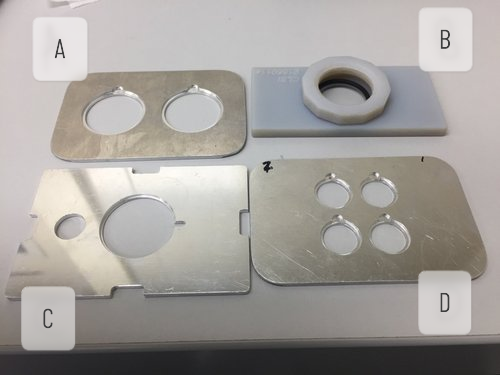
A) holder for two 25 mm CaF2 windows
B) Liquid cell, uses 25 mm CaF2 windows
C) Holder for one 25 mm CaF2 window
D) Holder for four 10 mm CaF2 windows
Windows
About windows
Calcium Fluoride (CaF2) are commonly used at Mid-IR as a sample support. The windows come in a variety of sizes and thicknesses. Sizes 25 mm and 10 mm (thickness 1 mm) are supported with the standard sample holders, other sizes can be accommodated, but arrangements must be made well in advance of beam time. Properties of mid-IR optic materials are listed in the table below.
|
Comparison of Common Infrared Optic Materials |
||||
|
Material |
Transmission Range (cm⁻¹) |
Index of Refraction |
Advantages |
Disadvantages |
|---|---|---|---|---|
|
CaF₂ |
66,000 - 1200 |
1.40 |
insoluble in water |
more expensive than BaF₂ |
|
BaF₂ |
50,000 - 900 |
1.45 |
lower cut-off than CaF₂ |
sensitive to water |
|
Ge |
5000 - 600 |
4.01 |
high refractive index |
|
|
ZnSe |
20,000 - 500 |
2.43 |
low cut-off |
soluble in strong acid |
|
ZnS |
22,000 - 750 |
2.25 |
insoluble in water |
soluble in acid |
|
Si |
10,000 - 100 |
3.42 |
insoluble in most acids and bases |
|
Where to buy
User groups will supply their own IR windows. They can be purchased from Crystran.
How to clean
Windows of different materials will have different cleaning protocols.
CaF2 windows can be cleaned with water and are acid/base resistant. The windows can be dried and gently polished with lens paper
BaF2 windows are extremely sensitive to water and should not come into contact with water.
** Using clean windows is incredibly important for collecting high quality data **
Storage
Samples mailed to the Mid-IR for mail-in or remote access experiments can be stored until beamtime. Some options include
-
Refrigerator (5 °C)
-
Freezer (-20 °C)
-
Extra cold freezer (-80 °C)
-
Desiccator
Need a storage location not listed? Please contact beamline staff to figure out a solution. Check out the CLS Laboratories & Equipment page for storage locations.
Sample disposal
Samples need to be removed when your beam time is finished. In the case of mail-in and remote access, samples will be returned to the user or disposed of if specific instructions are provided.