Background
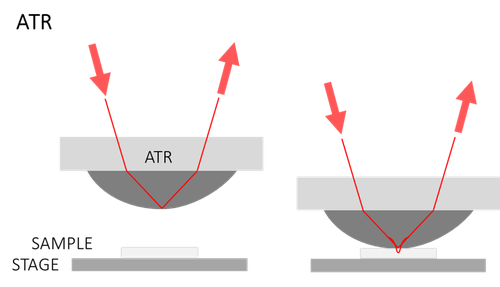
In an Attenuated Total Reflection (ATR) measurement, the internal reflection element (IRE) is pressed in contact with the sample. An evanescent wave penetrates the surface layer of the sample to a depth of between 0.3 and 3 µm as a function of the measured energy. The constant penetration depth limits the effective pathlength through the material and allows measurement of thick samples with
Samples
ATR is great for non-reflective samples and samples that cannot be thinly prepared (for transmission experiments). Direct contact between the germanium crystal and the sample is required and this may not be appropriate or desired in some cases.
Results
ATR spectra are similar to transmission Absorbance spectra and can be qualitatively directly compared. Quantitatively, the absorbance reported varies as a function of energy due to changing penetration depth, which can be corrected with a simple calculation.
In the case of ATR imaging, the field of view is fixed and limited. Unlike other imaging methods, the images cannot be stitched together to create larger effective areas.
Available Accessories at Mid-IR
Measurements which are possible depend on the ATR accessory used:
|
Accessory |
Endstation |
Measurement Type |
Source |
Internal Reflection Element |
|---|---|---|---|---|
|
Micro-ATR |
single point spectromicroscopy |
Synchrotron globar |
Ge |
|
|
Macro-ATR Imaging |
ATR imaging (200 x 200 µm FOV) |
Synchrotron globar |
Ge |
|
|
horizontal ATR microscope |
custom ATR imaging &
|
Synchrotron globar |
User-supplied |
|
|
ATR Imaging |
infrared chemical imaging (70 x 70 µm FOV) |
globar |
Ge |
|
|
Bulk ATR (PIKE) |
bulk ATR |
globar |
Ge |
|
|
Variable-angle ATR (PIKE) |
time-resolved spectroscopy |
globar ir laser |
User-supplied |